A comparative perspective
on human uniqueness
What makes us human? We believe that question only makes sense in comparative context. By placing our species alongside other species we identify which features of human anatomy, behaviour, and evolution are genuinely distinctive, which are shared, and which arose repeatedly across the tree of life. Human uniqueness becomes clearer, not weaker, when examined through a comparative lens.
News
Welcome to the Comparative Evolutionary Anthropology (CEA) group website at the University of Oxford.
New paper in PNAS: Competing models of hominin body size evolution — Gardner, Püschel, White, Sakamoto & Venditti.
Our work on human handedness was featured in The Independent: "Scientists finally decode why most humans are right-handed." The study links the rise of human handedness to the evolution of bipedalism and brain expansion in hominins. Read the paper →
New paper in PLOS Biology: Bipedalism and brain expansion explain human handedness — Püschel, Hurwitz & Venditti. Also featured in Oxford Anthropology news.
New paper in PNAS: The radiation and geographic expansion of primates through diverse climates — Avaria-Llautureo, Püschel et al.
New paper in PNAS: Hominin brain size increase has emerged from within-species encephalization — Püschel, Nicholson, Baker, Barton & Venditti.
The Lab
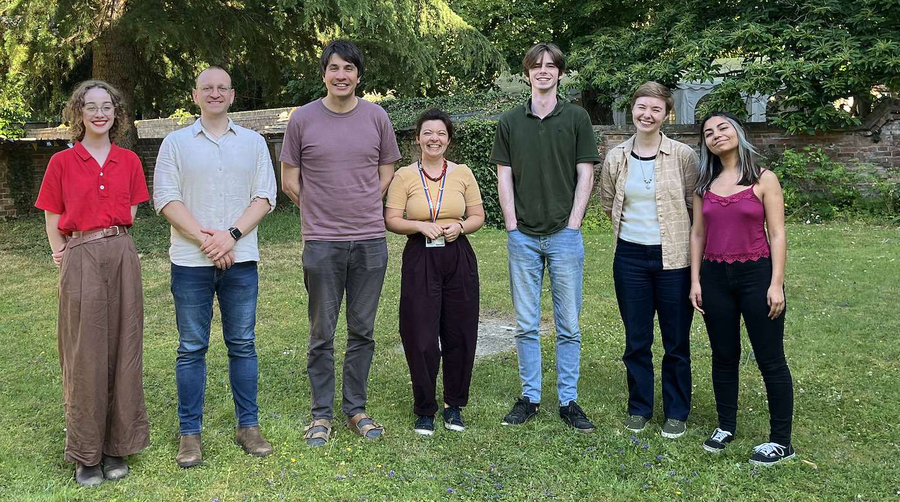
The CEA group, Oxford, 2025